Case studies · DisplayBuddy · programmatic SEO
How we grew clicks on programmatic
pages 2.3x for a Mac app.
DisplayBuddy is a Mac and Windows app for controlling external monitors. It had a large set of programmatic pages that were indexed, ranking, and going nowhere. We rebuilt them.
Results
August to September 2025 against the same weeks in 2026. Programmatic pages only, old and new URLs combined.
Google clicks
Programmatic pages, year on year
2.3x
Impressions
Programmatic pages, year on year
2.4x
Pages on page 1
Average position 10 or better
+39%
Pages Google shows at all
Share of the set with impressions
99%from 84%
Figure 1. Bars are illustrative. The multiples are from Search Console, pulled 1 October 2026.
Search Console · programmatic pages only · 16 months (the maximum it shows)
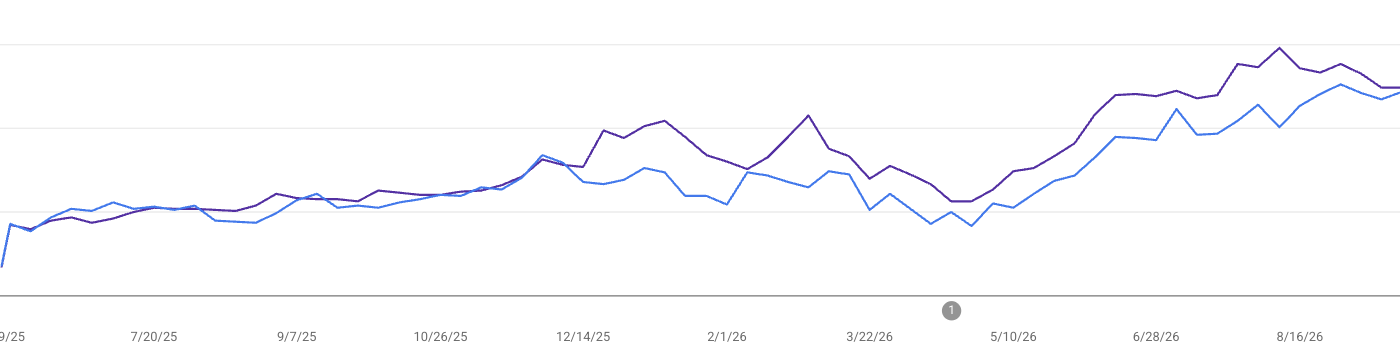
Flat, then a dip, then double
 1
2
3
1
2
3
- 1Feb 2026 Engagement starts. The nine months before it are flat.
- 2Apr URL migration ships. Google re-crawls the set and traffic dips for about six weeks.
- 3Jul to Sep Rebuilt pages take hold. Both lines settle at roughly double the 2025 level.
Figure 2. Search Console, programmatic pages only, weekly, 29 May 2025 to 28 Sep 2026. Purple is impressions, blue is clicks. Axis values removed at the client's request; the shape is untouched.
The starting point
The pages already existed and Google already knew about them. Many were on page 1. Clicks were flat anyway. Three things were holding the set back:
-
Dated URLs
Every page lived under a dated blog path. The date told Google and readers the content was old, and the blog folder put product pages next to opinion posts.
-
One template, one voice
Titles followed a single pattern, intros were interchangeable, and no page answered the question a searcher actually typed. Google treated them as near-duplicates.
-
No internal structure
Pages did not link to each other, to the glossary, or to the comparison pages. Each one stood alone, so authority never pooled.
What we did
-
1 · Migrate
URL cleanup
Every programmatic page moved out of the dated blog folder to a clean root path, with 301s, canonicals and sitemap updated in one release.
-
2 · Template refresh
Titles that match the query
A new title formula, tested on one brand first, then applied across the set. Intros rewritten to answer the question in the first two lines.
-
3 · Content refresh
Research, then rewrite
The highest-traffic pages got a manual pass: current model lists, the real on-screen menu paths, a troubleshooting section, and FAQs with schema so AI engines can quote them.
-
4 · Internal linking
Links and hubs
Brand pages link across OS, down to the glossary, and up to the comparison pages. Authority pools instead of leaking.
Alongside the programmatic work: comparison pages built or rebuilt, long-form guides, and a technical pass on crawl, schema and speed.
Page by page
The biggest movers in the set, same eight weeks a year apart. Two of them did not exist in 2025.
| Page | Clicks | Rank in set |
|---|---|---|
| /control-xxxx-brightness-on-windows | +66% | #1 |
| /control-xxxx-brightness-on-windows | new page | #2 |
| /control-xxxx-brightness-on-windows | 3.5x | #3 |
| /control-xxxx-brightness-on-mac | new page | #4 |
| /control-xxxx-brightness-on-windows | 2.8x | #5 |
| /control-xxxx-brightness-on-windows | 2.4x | #6 |
| /control-xxxx-brightness-on-windows | 11x | #8 |
Figure 3. Search Console page report, same eight weeks in 2025 and 2026, old and new URL for each page combined. "Rank in set" is the page's position by clicks among all programmatic pages in 2026; the two new pages went from nothing to the top five within six months. Brand names masked at the client's request.
AI citations
The same pages, with answer-first intros and FAQs, are what AI engines quote. Ask ChatGPT for a BetterDisplay alternative and DisplayBuddy is recommended, with a citation to its site.

What's the best alternative to BetterDisplay for controlling external monitor brightness on a Mac?

Figure 4. ChatGPT, checked 1 October 2026.
Method notes
- Why year on yearThe URL migration in April 2026 caused a dip while Google re-crawled the set. Comparing the six months before the engagement with the six months after puts that dip inside the "after" window: clicks +19%, impressions +32% on the same pages. The eight-week year-on-year view above is the fairer read of where the set is now. Both are real; pick the one you trust.
- What's in the setEvery programmatic page, old blog path and new root path combined. Comparison pages, guides and the homepage are excluded.
- What it is notNot whole-site numbers, not revenue, not a ranking guarantee. The whole site is up 77% on impressions and 41% on clicks over the same eight weeks; the programmatic set is where most of that came from.
Have pages that should
be doing more?
One call. I study your site, content and competitors before it. Or write to [email protected].